Google Ads management Houston
Running Google Ads but not getting the calls you expected? If you’re a business owner in Houston who wants steady leads without spending hours inside the ad dashboard, I can help.
I handle Google Ads management end to end, so you don’t have to guess, tweak, or babysit campaigns that never seem to improve.
As your Google Ads manager, my focus is clear:
-
Eliminate wasted spend from clicks that never turn into customers
-
Get your offer in front of Houston searchers with real intent
-
Convert traffic into qualified leads, not just activity
The idea is simple. Doing it right takes experience, time, and constant attention.
If you don’t want Google Ads to be another thing on your plate, you’re in the right place.






Some Google Ads Results
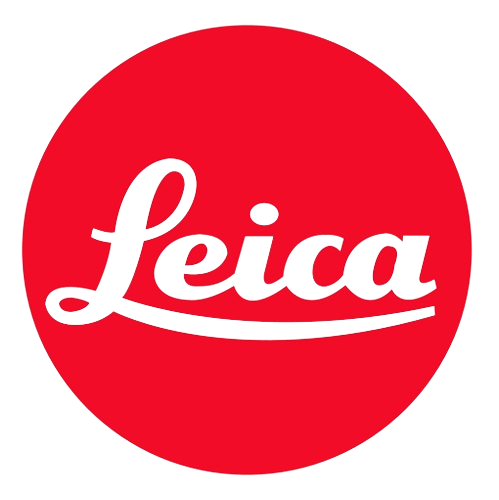
Vedas Med Spa in Houston generated over 2,800 leads while cutting cost per lead to $47.85, down by nearly $60 per lead.
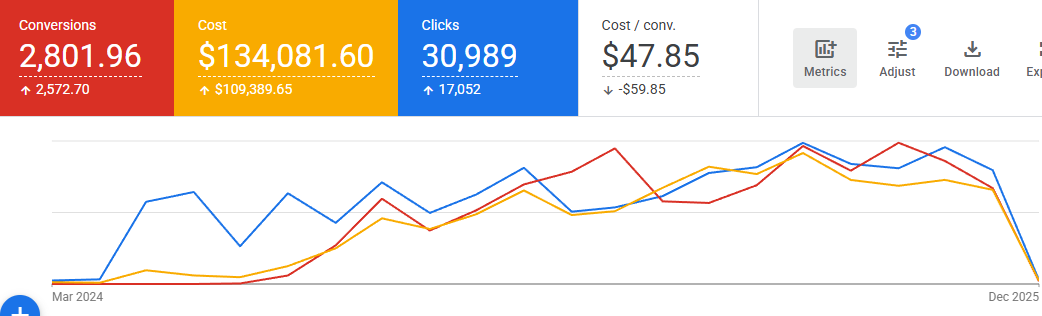
This law firm in Houston increased leads by 453% and reduced cost per lead by 60% within 4 months.
How I Approach Google Ads
Most Google Ads campaigns don’t fail because of bad settings.
They fail because there was never a real strategy.
People jump into the platform, copy competitors, turn on automation, and hope clicks turn into leads. Sometimes they do. Most of the time, they don’t.
That’s not marketing. It’s guesswork.
Here’s the truth most people avoid:
Google Ads don’t create results on their own. Your offer does. Your message does. The process behind it does.

You can build a flawless campaign and still lose money if what you’re offering doesn’t make sense to the person searching.
That’s why I don’t start with keywords or bid strategies. I start by understanding the business. And in competitive markets like Houston, where clicks aren’t cheap, skipping this step gets expensive fast.
Who is your customer?
What are they actively searching for?
Why should they choose you over every other option on the page?
Until those answers are clear, no amount of automation, smart bidding, or optimization will fix the problem.
Yes, the technical side matters. If you send the wrong traffic, use a page that doesn’t convert, or track the wrong actions, you’ll pay for clicks while your competitors collect customers.
But even when everything is built correctly, results still come down to fundamentals that never change:
the right offer, the right message, shown to the right person, at the right moment.
That’s the difference between an account that spends money and one that makes it back.
How I Manage Google Ads
1) Audit the account and stop the leaks
I start by reviewing the entire account, what campaigns are running, which keywords trigger ads, what the ads say, who they’re shown to, and how leads are tracked. Then I line everything up with your actual business goals, so the services that matter most get the budget they deserve. I also keep brand and non-brand searches separate, so the results are easy to understand and not mixed together.
Next, I look closely at where the money is going. I cut wasted spend from low-quality traffic, remove placements that don’t bring leads, and review devices and times of day that burn budget without producing results. I also read the actual search terms people typed in, so we focus on real buyer intent, not just keywords that look relevant. This is especially important in competitive markets like Houston, where every click costs more.
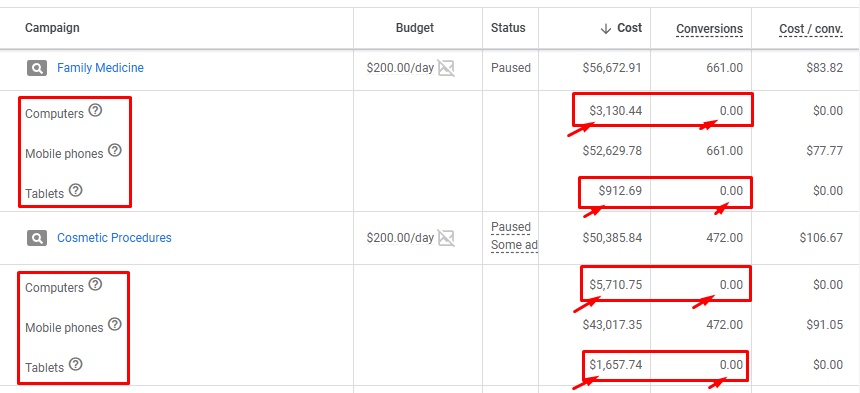
During audits, it’s common to find thousands of dollars spent on desktop or tablet traffic with zero results, while mobile brings in nearly all the leads. When that happens, I either fix what’s underperforming or move that budget into what’s already working. That one change alone often improves results by 20–30%.
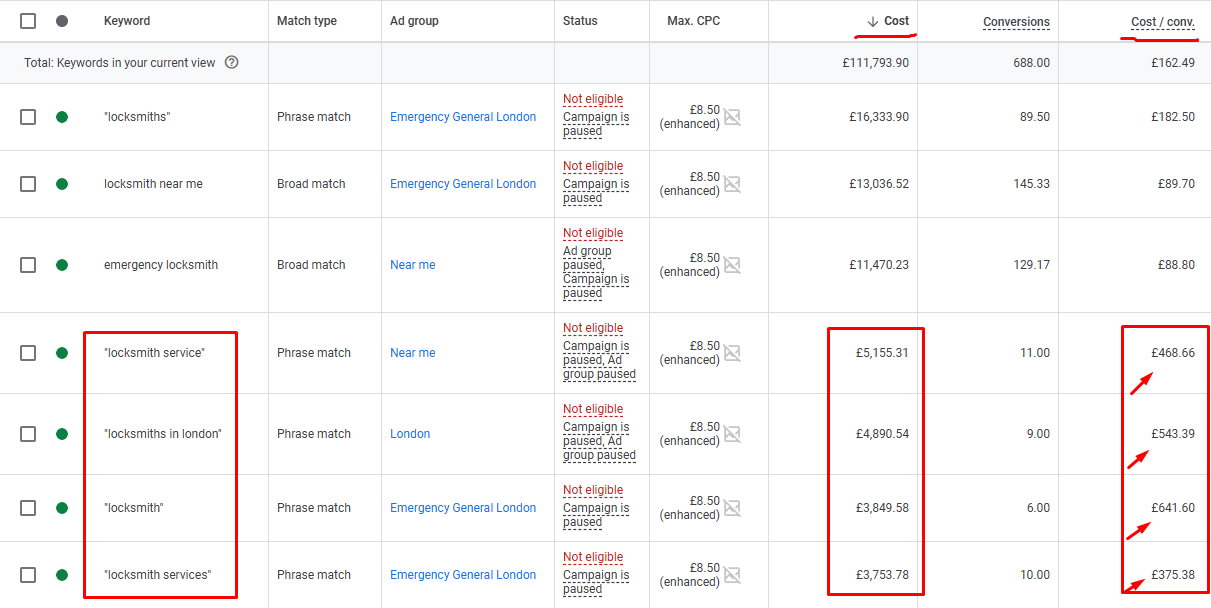
I also look at which keywords are using the most budget to find hidden money leaks, terms that sound relevant but don’t actually bring in leads. Every account has them. By lowering bids or cutting these high-spend, low-return keywords, results often improve quickly. In one local locksmith account, a few keywords had burned through thousands of dollars with costs over $500 per lead. Removing them alone cut the overall cost per lead by nearly 50%.
During the audit, I also make sure the “conversions” are real. A page view or “one minute on the site” isn’t a lead. A real lead is a form submission or a phone call that lasts 30 to 60 seconds. If the tracking isn’t accurate, I fix it so the data reflects what’s actually happening.
From there, I focus on quick wins. I tighten negative keywords (often saving around 30% of wasted spend), adjust location targeting so ads only show to people who are actually in or regularly in your area, and shift budget to the times of day and devices that produce leads. I also build out all ad extras like sitelinks, callouts, and images, and make sure every ad sends traffic to the right landing page with a clear offer and one main call to action.
2) Regain Control (turn off Google’s autopilot)
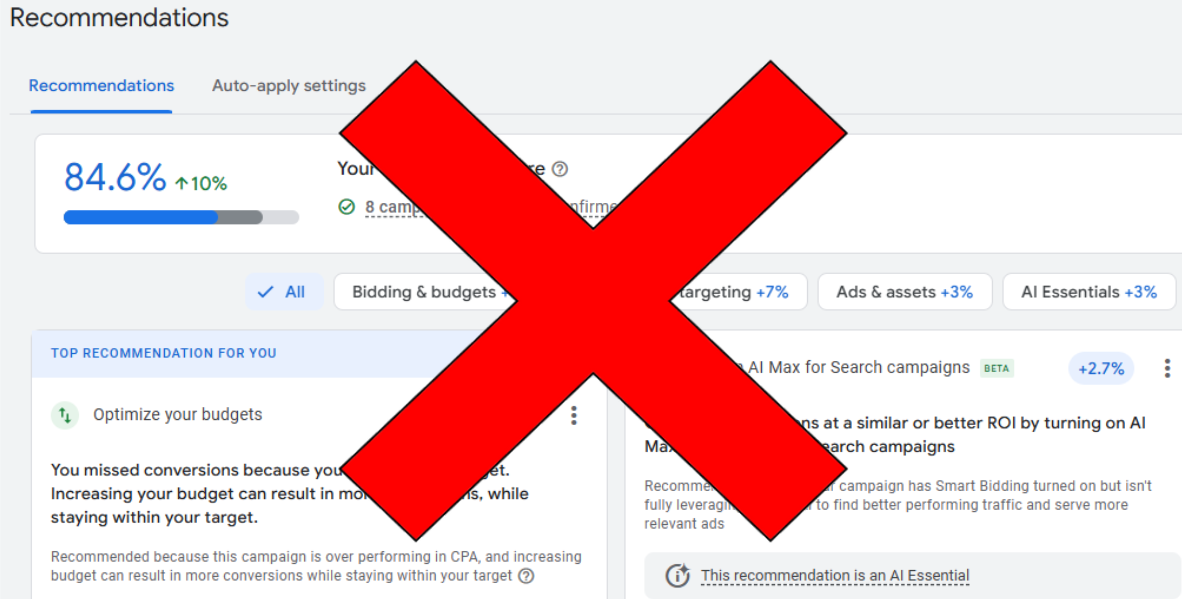
After the audit, the goal is simple: take control back. I turn off auto-applied recommendations, ignore the “optimization score,” and focus on what actually helps your business. A high score doesn’t matter if it isn’t bringing better leads or lower costs. Good PPC work means reviewing Google’s suggestions, not automatically accepting them.
Many accounts have hidden automation quietly changing bids or adding keywords that don’t belong. Over time, that creates confusing data and drives costs up.
This step is about cleaning all of that up and making sure every setting supports your goals, not Google’s. Once control is back and the numbers make sense again, we can move forward with a clear plan and build the account the right way.
3) Campaign Structure: simple on purpose
Every account I build starts lean and focused, not overloaded. The setup depends on your budget, search demand, and how competitive your market is. A business spending $2,000 a month doesn’t need the same setup as one spending $200,000. Complexity should grow only when results justify it.
I rebuild accounts into a small number of focused campaigns, each with a clear goal. Ad groups are tight, keywords show real buying intent, and the ad copy matches what people are actually searching for. Campaigns that already perform well are kept separate from tests, so experiments don’t disrupt what’s working.
Most advertisers build too much too fast (I used to do the same), then spend weeks fixing problems they created. I take the opposite approach: start simple, learn quickly, and scale only when the data proves it makes sense.
The goal isn’t a huge, complicated account. It’s a structure that’s easy to understand, easy to manage, and easy to scale as results improve.
Campaigns are organized by intent, not random labels. Each ad group focuses on one offer and one goal. Brand searches stay separate from non-brand searches, and high-intent searches like “call now” don’t compete with research terms like “cost” or “reviews.”
Once campaigns are live, growth is handled carefully:
-
Invest more in what’s working
-
Keep things tight until they prove themselves
-
Move budget to winners and cut waste
-
Avoid unnecessary complexity that drives up costs
I treat campaigns like building a house: start with a solid foundation, then build up. When Google’s learning phase kicks in, a clean structure scales smoothly instead of falling apart.
4) Optimization: steady, goal-focused work
When I optimize a campaign, I focus on the three things that actually drive results: the ads, the keywords, and the landing pages.
1) Using the right type of campaign
Many service businesses use Performance Max or Smart campaigns that give Google full control. That can work for online stores, but it usually hurts lead generation. I stick with focused Search and Call campaigns, where we control which searches trigger ads and how the budget is spent. This improves lead quality quickly.
2) Keywords that bring real customers
Early on, I review every search term that triggered an ad. The good ones stay. The junk gets blocked—not just single keywords, but entire themes like “cheap” or “DIY” so they don’t keep coming back. This pushes more of your budget toward people who are ready to buy.
3) Landing pages built to convert
Sending paid traffic to a regular website often hurts results. Most people aren’t there to browse—they want a phone number or a quick form. I use simple, focused landing pages designed to get action, where the message, layout, and offer all work together.
When ads, keywords, landing pages, and the offer are aligned, Google rewards that with lower costs per click and more leads.
Optimization happens through:
-
Weekly check-ins and adjustments
-
Ongoing testing of ads and page layouts
-
Small offer changes that can significantly boost conversion rates
Once there’s enough clean data, I usually switch to automated bidding (like Target CPA or Maximize Conversions) so Google can scale based on what’s already proven to work.
5) Reporting: clear and honest
I’m not here to wow you with flashy dashboards. I focus on tracking what actually matters using reliable tools.
No inflated numbers.
No fake “conversions.”
No smoke and mirrors.
You’ll have access to a live dashboard that shows the real numbers: ad spend, leads, cost per lead, and phone calls. Each week, I record a short Loom video walking you through performance, what changed, and why.
You’ll always know what’s working, what’s not, and exactly what I’m doing to improve it.
This isn’t for everyone
I don’t promise instant or “magic” results. Anyone who does isn’t being realistic.
If you’re expecting overnight success or think ads alone will fix a struggling business, we’re probably not a good fit.
If your margins can’t support the real cost of Google Ads, I’ll tell you that upfront. And if your budget is small but your expectations are high, I’ll be honest about what’s possible.
In major cities like Houston, TX, clicks can get expensive fast. When clicks cost $20 or more, $15 leads just aren’t realistic, no amount of “AI magic” changes that.
There are agencies that sell hype. They promise quick wins, perfect timelines, and flashy dashboards. I don’t. I focus on what actually works, even when it’s not what people want to hear.
Some people want reassurance more than results. The ones who stick around want the truth. They understand Google Ads isn’t about hacks or shortcuts, it’s about clear strategy, discipline, and real numbers.
If that approach makes sense to you, we’ll work well together.
If not, there are plenty of others happy to tell you what you want to hear.
What my clients are saying
Common questions
What types of campaigns do you usually run? Search, Display, or Performance Max?
I usually start with Search campaigns. That’s where the strongest intent is, people are actively looking for what you offer, not just scrolling past ads. Once we’re getting consistent leads and solid data, I’ll add Performance Max to help Google find more of those same high-intent customers.
Display (or Demand Gen) usually comes later, mainly for remarketing and staying top of mind with people who already visited your site.
In short: Search first for proven ROI, then scale with Performance Max and Display when it makes sense.
When should I expect to see results?
Most campaigns start showing strong, consistent results around 90 days.
Here’s how it usually plays out:
-
Month 1: Google is learning. You’ll see clicks and some early leads.
-
Month 2: Traffic quality improves and leads become more consistent.
-
Month 3: The campaign settles in and delivers steady results.
The key is keeping the budget consistent and giving Google time to learn.
Do you run experiments or A/B tests?
Yes—constantly.
-
Landing pages: I test headlines, CTAs, images, layouts, even button styles. One change at a time, clean 50/50 tests. Small tweaks can boost conversions by 30–40%.
-
Ads and offers: I test different headlines and descriptions to improve click-through rate and lower cost per lead.
-
Bidding strategies: I test manual bidding against automated options like Max Conversions or Target CPA using controlled splits, so we don’t risk what’s already working.
The winners stay. The rest get cut.
What do you count as a “conversion”?
Not fluff like page views or time on site.
A real conversion shows clear intent:
-
A form submission
-
A phone call lasting 30–60 seconds or longer
-
A completed sale
Everything is tracked properly, with call tracking in place, so we know which leads are real. No fake conversions.
Do you write the ad copy, or do I?
I handle the ad copy as part of the setup. Every line is written to match your offer and speak to your audience.
Nothing goes live without your approval. You’ll always review the headlines and descriptions first and can request changes before launch.
Do you build landing pages, or use what I already have?
Both, it depends on what will get better results. If your current pages are converting well, I’ll use them and make small improvements. If not, I can build a dedicated landing page that matches your offer and message, keeps things simple, and is designed to drive action. Landing pages are included in the campaign setup, there’s no extra cost.
What’s the minimum budget I should start with for Google Ads?
If you’re just starting out, a realistic minimum is around $2,000 per month (about $65 a day). In a competitive market like Houston, that’s usually the floor, not the ceiling.
Anything lower rarely gives Google enough data to learn what’s working or who your best customers are. You might get clicks, but not enough real leads to make smart decisions. That’s when people assume Google Ads “doesn’t work,” when in reality the campaign just didn’t have enough budget to learn.
Starting around $2,000 per month gives the algorithm room to collect data, optimize, and deliver results you can actually measure and improve.
How does budget size affect campaign management?
With a smaller budget, everything has to be tight and intentional. We focus on a short list of high-intent keywords, move carefully, and expand only once we see what’s working. Results can take longer in competitive markets, but this approach builds a strong foundation.
With a larger budget, there’s more room to test ads, audiences, and bidding strategies. Growth can happen faster, but scaling too quickly can backfire. I increase budgets gradually once campaigns are stable to avoid performance drops or wasted spend.
In short: small budgets require patience and focus. Larger budgets require structure, testing, and close monitoring.
What happens before the ads go live?
Before anything launches, I review your offer, website, and competitors. Then I set up tracking, write the ad copy, and build the campaign structure so everything works together. Nothing goes live until the keywords, message, and landing pages are ready to convert. It takes a few days, but it saves weeks of wasted ad spend later.
How do you make sure the leads are good quality?
I don’t just count leads, I check them. I listen to call recordings in CallRail to separate real inquiries from junk. I can also see which search terms triggered each call, so we double down on what brings quality leads and cut what doesn’t. If leads aren’t turning into customers, I dig into why, whether it’s the keywords, ad copy, or landing page. The goal isn’t more leads, it’s better ones.
How often do we communicate?
You’ll get weekly or biweekly updates, usually through a short Loom video or message, explaining what changed, why it changed, and what’s next. You won’t have to chase me for updates, and you’ll always work directly with me.
Do you work alone or have a team?
I work solo and manage every account myself. No juniors, no outsourcing, no handoffs. The same person who audits, builds, writes, and optimizes your campaigns is the one you’re working with.
How many clients do you take on?
I keep my client list small, usually around ten active accounts. I’m not interested in juggling dozens of campaigns. This lets me stay focused, do better work, and only take on clients I know I can actually help.
Can you fix my existing Google Ads campaigns instead of starting over?
Yes, if there’s a solid foundation, I’ll improve what’s already there. If the account is built on shaky ground, a rebuild usually makes more sense and often costs less in the long run.
Do you connect ads to CRMs or track leads after they come in?
Here are a few keywords to get us connected:
google ads houston
google ads specialist houston
adwords manager in houston
google ads management houston, TX
adwords agency houston, TX
google adwords houston, TX
houston google ads
houston google ads agency
google specialist near me in houston